Drying Rivers to Dying Camels: Extreme Heat Reveals Climate Change Inequality
- Berrak Gümüşsoy
- Jul 31
- 4 min read

Europe’s climate emergency dominates international headlines: record heat, worsening drought, overwhelmed infrastructure. Meanwhile, communities across the Middle East and Africa have long confronted similar conditions with far weaker access to water and public health protection. Why is it that Europe can still treat extreme heat as an emergency whilst equally serious climate suffering is normalised for the rest of the world? Could European governments learn from societies that have been adapting for decades?
According to Politico, a late-June heatwave fueled by the human-caused climate crisis resulted in at least 14 thousand excess deaths across several European nations. The Guardian reports that France and Spain have evacuated approximately 220 thousand and 100 thousand people, respectively, as wildfires spread under renewed extreme heat.

Climate change is altering the pattern of European drought: The World Weather Attribution found that conditions driving water evaporation were made 80 times more likely in western and 40 times more likely in eastern Europe.
Across the Middle East and Africa, the same environmental hazards tend to be more destructive because they reach communities with far thinner margins of safety. BBC reports from Ethiopia’s Afar region that because of climate change-induced heating, camels are now developing blisters on their feet and watery eyes, whilst scorching sand burns their skin and strips away their hair. Heat stress, declining water availability, and inadequate veterinary care are also contributing to fatigue, disease, and death in animals biologically adapted to survive extreme heat and drought.
Reuters reports that wildfires across Algeria, Morocco, and Tunisia are increasing, whilst warning that a powerful “El Niño” (unusual warming of surface waters in the Pacific) could cost African economies between $10 bn and $20 bn through damaged infrastructure, worsening food and water insecurity, and forced displacement.
In Iraq, years of drought have completely dried parts of the historic marshes, killing livestock and forcing families to migrate. While the recent rainfall has allowed some residents to return, their recovery remains dependent on unstable water flows. All these experiences within the MENA region are singular examples of how extreme weather conditions do not act as temporary events when households are mandated to repeatedly rebuild livelihoods without reliable systemic protection.
The climate resilience gap is fundamentally an infrastructure gap between populations who can activate public protection and those expected to adapt privately. The Guardian notes that extreme heat across much of the Global South coincides with unreliable electricity, overcrowded housing, and limited public-health capacity. Hence, even owning an air conditioner offers little to no security if power itself is unaffordable or unavailable.
Europe itself remains inadequately prepared as EU climate advisers estimate annual climate-related losses of about €45bn and warn that adaptation policy remains fragmented. However, climate disasters in wealthier regions receive greater international visibility. The University of Zurich recently found that British newspapers disproportionately covered disasters in Europe and North America, whilst a separate analysis of 135 million articles showed that slow-moving crises such as drought and extreme heat, concentrated in the Global South, received much less cross-border attention.
Similar inequality shapes the production of climate knowledge. Coupled Model Intercomparison Project (CMIP), whose models inform the Intergovernmental Panel on Climate Change (IPCC) assessments and governmental planning, has acknowledged that its contributing institutions remain concentrated in the Global North, whereas researchers in more vulnerable regions face limited access to both computational infrastructure and specialised training. When these regions have so little influence over the models used to predict climate risks, it is no surprise that the resulting research is not capable of addressing their needs or them at all.
Communities operating under scarcity have developed practical forms of resilience Europe can learn from: An Al Jazeera analysis highlights West African buildings that use reflective roofs, thick locally sourced walls, and intentionally designed ventilation to cool indoor spaces without energy-intensive air conditioning. Freetown’s “Tree Town” programme addresses urban heat through large-scale planting, whereas Burkina Faso’s heat-alert system combines warnings with hydration campaigns and checks on vulnerable residents.

Such measures cannot simply be copied without regard for local conditions, but they do demonstrate that adaptation knowledge need not necessarily flow from wealthier countries to poorer ones. Closing the resilience gap requires recognising Southern communities as producers of tested practical knowledge that has been undervalued because of its origins.
Türkiye, bridging MENA and Europe, shows how a country with relatively strong institutions can still be pushed towards the water insecurity already entrenched across much of its Eastern neighbours. In Konya, declining rainfall, extreme drought, and water-intensive farming have contributed to the formation of nearly 700 major sinkholes, according to the Guardian. The region has also lost 186 of its 240 lakes over six decades, and some farmers now drill 90 meters searching for groundwater that was once found at 30 meters.
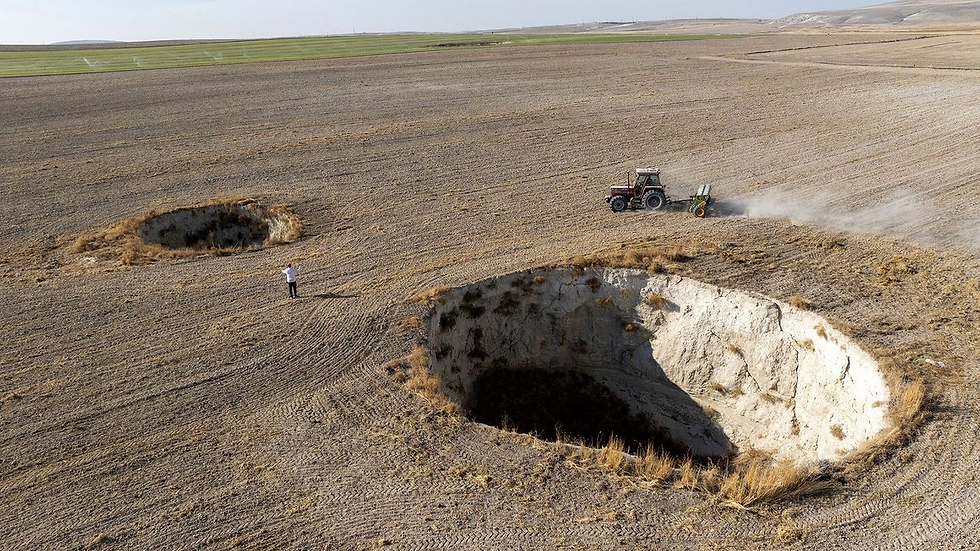
Yet, having more institutional and financial capacity than many of its neighbours, Türkiye makes its failures harder to dismiss as unavoidable. As the country prepares to host COP31 in Antalya in November 2026, its response to groundwater depletion and agricultural stress will test whether governmental leadership diverges from international promises.
The climate resilience gap persists because adaptation remains severely underfunded. Developing countries may need between $310 billion and $365 billion annually by 2035, yet international public adaptation finance reached only about $26 billion in 2023, according to the United Nations Environmental Programme’s latest Adaptation Gap Report.
Recent funding increases have not closed this divide. Multilateral development banks committed a record $162.5 billion to climate finance in 2025, but only $35 billion went towards adaptation, compared with $68 billion for emissions reduction; the World Bank’s decision to abandon its target of directing 45 per cent of lending towards climate projects has also raised concerns about future support.
The climate divide is between populations protected by functioning systems and those expected to endure each new shock alone. Europe’s fires, deaths and infrastructure failures show that wealth can not provide immunity, yet it still determines whether disaster is treated as a temporary emergency or absorbed into everyday life. The heat may not discriminate, but the systems designed to protect people from it still do.
Sources: BBC, Al Jazeera, Reuters, The Guardian
Written By: Berrak Gümüşsoy
Edited By: Cemre Sanlav


